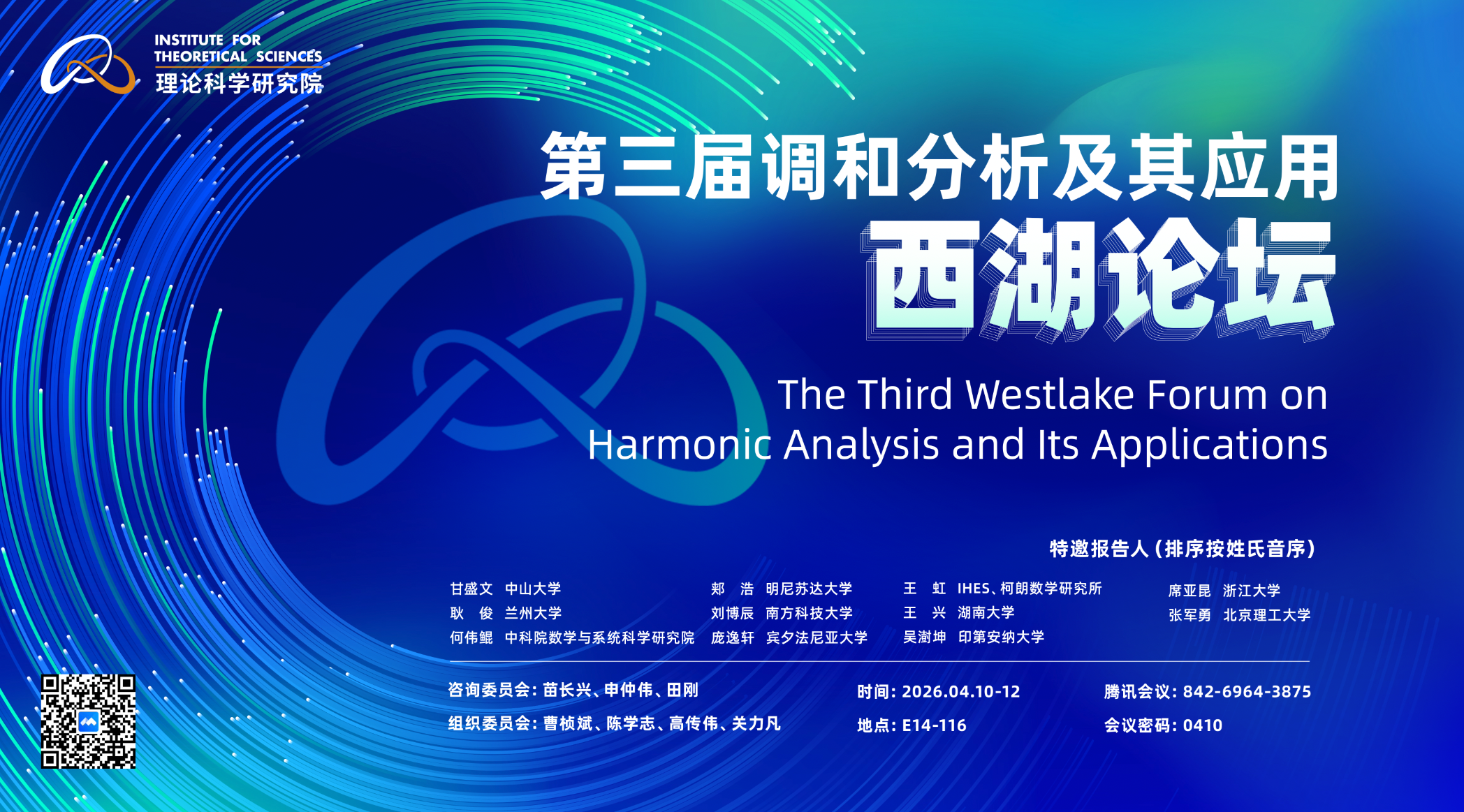
Time:April 10 - April 12 2026
Venue: E14-116
Tencent Meeting: 842-6964-3875
PASSCODE: 0410
April 10
9:00-10:10
Speaker: Hong Wang, IHES (Online)
Title:A survey of Stein's restriction conjecture
Abstract:Stein's Restriction conjecture concerns functions whose Fourier transform is supported on the unit sphere in R^n. Over the decades, progress on this problem has drawn on tools from combinatorics, real algebraic geometry, and other areas. We will survey the development of the conjecture and discuss its recent connections to projection theory.
10:40-11:50
Speaker: Jun Geng, Lanzhou University
Title:Neumann Problems for the Stokes Equations in Convex Domains
Abstract:This paper studies the Neumann boundary value problems for the Stokes equations in a convex domain in $\mathbb{R}^d$. We obtain nontangential-maximal-function estimates in $L^p$ and $W^{1, p}$ estimates for $p$ in certain ranges depending on $d$. This is a joint work with Professor Zhongwei Shen.
April 11
9:00-10:10
Speaker: Hao Jia, University of Minnesota (Online)
Title: Sharp asymptotic stability of Kolmogorov flows on a non-square torus
Abstract: The Kolmogorov flow is an important metastable state for the two dimensional Navier Stokes equations on a (non-square) torus when the viscosity is $\nu\ll1$. It was first proposed by Kolmogorov in 1959 as a model to study transition to turbulence. Yudovich proved global stability of the Kolmogorov flow and showed that perturbed solutions converge back to the Kolmogorov flow with the exponential rate $e^{-\nu t}$ as $t\to\infty$. However, numerical simulations have revealed that a large family of solutions relax at a much faster rate. For a long time, the precise mechanisms for such rapid convergence were not understood, despite much effort. In this talk, we present a recent result showing that when the perturbation is of size $\ll \nu^{1/3}$ in $H^3$, the perturbed solution converges to a shear flow with a fast, optimal rate $\frac{1}{1+\nu t^3} e^{-c_0\nu^{1/2}t}$, before settling down to the Kolmogorov flow and slowly decaying to 0. The threshold $\nu^{1/3}$ is expected to be sharp, and is quite surprising since it is the same as that for the much simpler Couette flow where linear decay is significantly stronger. The proof relies essentially on sharp estimates on all three known stabilizing mechanisms for incompressible fluid equations: inviscid damping, enhanced dissipation and vorticity depletion. Based on joint work with Qi Chen, Dongyi Wei and Zhifei Zhang.
10:40-11:50
Speaker: Yixuan Pang, University of Pennsylvania (Online)
Title:Weighted mixed-norm estimates for circular averages and exceptional set estimates for the wave equation
Abstract:We prove new weighted mixed-norm estimates for circular averages, using circle tangency bounds and a discretized slicing lemma for fractals. These estimates can be seen as X-ray-type extensions of Wolff's and Bourgain's circular maximal functions. As applications, we obtain new exceptional set estimates for the radial integrability of functions in Lebesgue spaces, as well as for the Hölder regularity in time of solutions to the linear wave equation on R^2. The latter results are the first of their kind. This is joint work with Chenjian Wang.
14:00-15:10
Speaker: Xing Wang, Hunan University
Title: Problems related to eigenfunctions on compact manifolds
Abstract: In this report, I will share my perspective on eigenfunctions on compact manifolds based on my recent work, along with some open problems related to my research.
15:30-16:40
Speaker: Junyong Zhang, Beijing Institute of Technology
Title:Geodesic flow focusing and dispersive estimates
Abstract:In this talk, we will present recent results on pointwise dispersive estimates for Schrödinger operators on manifolds with conical singularities. We will discuss how the geometry of the geodesic flow, particularly the phenomenon of focusing, influences the long-time decay of solutions. This work is based on a series of joint papers with Q. Jia (Australian National University).
16:50-18:00
Speaker: Shengwen Gan, Sun Yat-sen University
Title: Some new estimates for Falconer's distance set problem
Abstract: Given a set E in R^2, the distance set of E is defined as \Delta(E)={ |x-y|: x,y \in E }. It is conjectured that if the Hausdorff dimension of E exceeds 1, then \Delta(E) has positive Lebesgue measure. In this talk, I will first discuss the history of this problem and survey some classical approaches. I will then introduce some new ideas that help to improve the previous results. This is a joint work with Bochen Liu and Shukun Wu.
April 12
9:00-10:10
Speaker: Shukun Wu, Indiana University (Online)
Title: Two-ends incidence estimates with applications
Abstract: For a small parameter \delta, let L be a \delta-separated family of truncated lines in [0,1]^n. For each such line, let the shading Y(l) be a union of \delta-balls contained in the \delta-neighborhood of l. Finding lower bounds for the volume of the union of these shadings under various assumptions has appeared to be inevitable in modern Fourier analysis since Bourgain's foundational work in 1991. In this talk, we study the case where the shadings Y(l) satisfy a weak non-concentration assumption, namely the two-ends condition, and discuss some of its applications. We also give a streamlined proof sketch of the two-ends Furstenberg estimate in the plane, using the Furstenberg set estimate as the only black box. We hope this offers a clean illustration of the recent "small multiplicity--large volume" methodology.
10:40-11:50
Speaker: Bochen Liu, Southern University of Science and Technology
Title: Lebesgue measure of distance sets with regular pins and multi-scale Mizohata-Takeuchi-type estimates
Abstract: I prove that, if a regular planar set has dimension greater than 1, then its distance set must have positive Lebesgue measure. This settles the regular case of the Falconer distance conjecture in the plane.
14:00-15:10
Speaker: Yakun Xi, Zhejiang University
Title:Restriction conjecture, Bochner-Riesz conjecture and a question of Hörmander
Abstract:This talk presents progress on the restriction problem, Bochner–Riesz summability. In particular, we provide a full solution to a question of Hörmander.
15:30-16:40
Speaker: Weikun He, AMSS
Title:Quantitative Brascamp-Lieb inqualities
Abstract:I will present a new estimate on the constant in Brascamp-Lieb inequalities. This can be regarded as a generalisation of the finiteness criterion of Bennett-Carbery-Christ-Tao. This work is motivated by its applications to projection theory and to dynamical systems. Based on joint work with Timothée Bénard.